Little Spoon Formula Review 2026: Organic Whole Milk, Ingredients & Testing
Little Spoon's Organic Whole Milk Infant Formula combines grass-fed New Zealand whole milk, organic lactose, and unusually detailed batch-level testing. Here is what the formula offers, what it leaves out, and where the evidence stops.
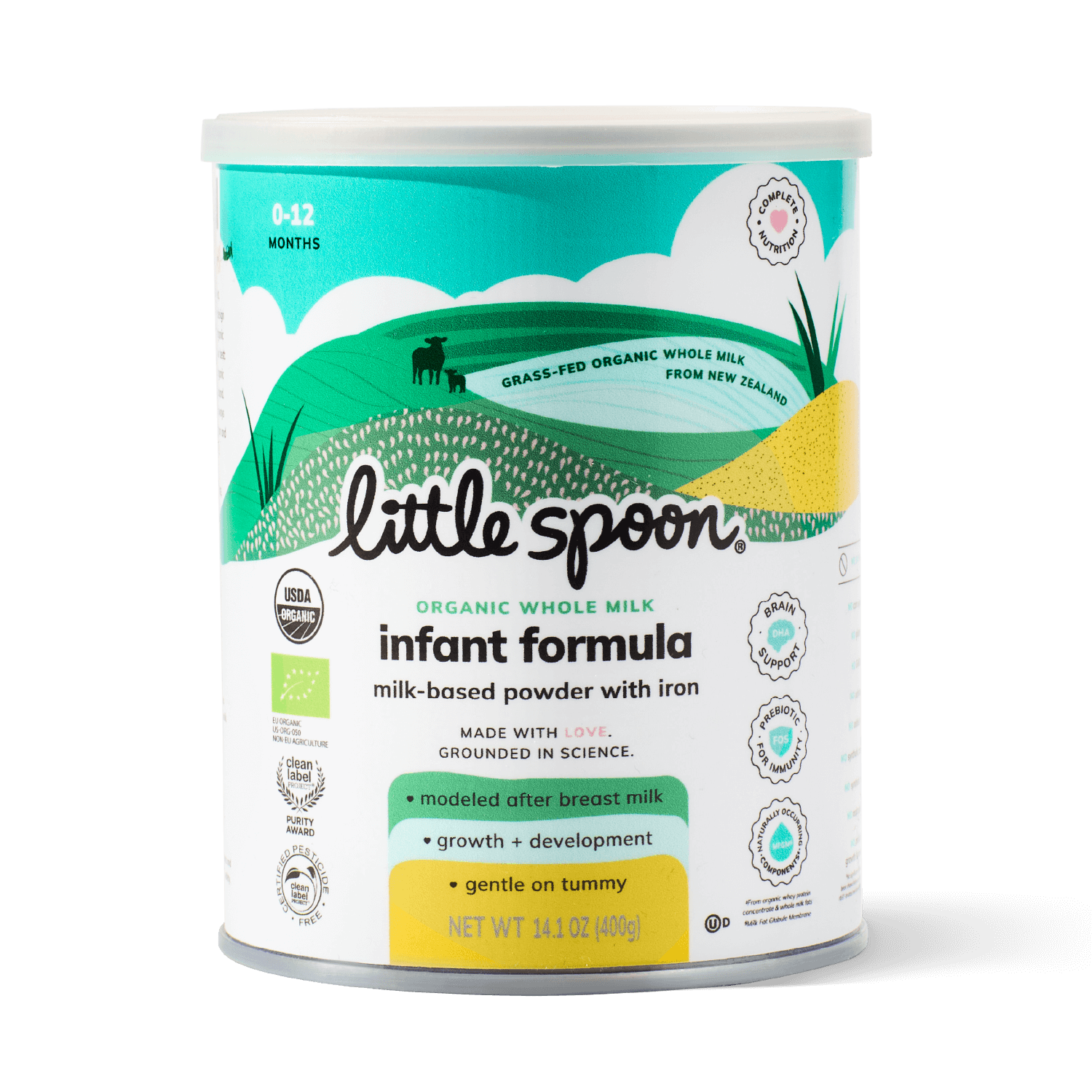
What parents should know
- ✓ Complete infant formula labeled for ages 0–12 months
- ✓ Organic lactose with a 60:40 whey-to-casein ratio
- ✓ Organic whole milk sourced from grass-fed cows in New Zealand
- ✓ Batch-level testing results are published by lot code
- ✓ Contains milk; it is not hypoallergenic
What Little Spoon formula is
Little Spoon Organic Whole Milk Infant Formula is a powdered, cow's-milk-based formula designed to provide complete nutrition from birth through 12 months when prepared and fed as directed. Organic lactose is its main carbohydrate—the same type of carbohydrate found in human milk—and the protein blend uses a 60:40 whey-to-casein ratio.
The recipe begins with organic whole milk from grass-fed New Zealand cows. Whole milk supplies naturally occurring milk fat and MFGM components, although the presence of an ingredient or component by itself does not prove better tolerance or outcomes for an individual baby.
Ingredients and nutrition highlights
- Five nucleotides: AMP, CMP, GMP, IMP, and UMP—the five nucleotides identified on the current ingredient list.
- Prebiotic FOS: Fructooligosaccharide is included as a prebiotic ingredient.
- DHA and ARA: 20 mg DHA and 34 mg ARA per 100 calories, per Little Spoon. That is the brand's figure; it is not shown on the nutrition panel published on the product page, which lists DHA and ARA sources in the ingredients.
- L-carnitine: Included in the micronutrient blend.
- Naturally occurring MFGM components: Supplied by the whole-milk ingredient; Little Spoon does not claim that this makes the product equivalent to human milk.
What is not on the current formula label
The current recipe contains no corn syrup, palm oil, soy, maltodextrin, gluten ingredients, or genetically modified ingredients. Ingredient lists can change, so check the can you receive—especially when managing an allergy.
Safety testing and transparency
This is Little Spoon's clearest differentiator. The company says every finished batch is independently tested by an accredited third-party laboratory and publishes lot-level results, including numerical heavy metal results, in its public testing hub.
Little Spoon says it tests for more than 500 potential contaminants (the brand cites a 552-item panel). Its public testing hub displays the results under the six categories below. We use six here because that is what parents can presently verify on the public page.
| Published category | Examples shown by Little Spoon |
|---|---|
| Heavy metals | Arsenic, cadmium, lead, and mercury |
| Pathogens | Cronobacter, Salmonella, Listeria, and Staphylococcus aureus |
| Plasticizers | BPA and BPS |
| Pesticides and glyphosate | Glyphosate and a broad pesticide screen |
| Hygiene indicators | Enterobacteriaceae and aerobic plate count |
| Toxin-producing and spore-forming bacteria | Bacillus cereus and sulfite-reducing clostridia (SRC) |
Little Spoon says it voluntarily screens SRC at a threshold 10 times stricter than international guidance; its product page lists its SRC standard as ≤10 CFU/g. SRC testing is an indicator for spore-forming bacteria; it does not directly test for or guarantee the absence of Clostridium botulinum. Published testing is useful transparency, but no testing program makes powdered formula sterile. Follow the can's preparation and storage directions exactly.
Certifications
- USDA Organic
- Certified to the EU Organic Equivalency Arrangement
- Clean Label Project Purity Award
- Clean Label Project Certified Pesticide-Free
- Clean Label Project First 1,000 Day Promise
- Kosher Dairy
Little Spoon lists these certifications on its product page and testing hub. The Kosher Dairy certification is listed in Little Spoon's March 17, 2026 launch announcement and shown as an OU-D mark on the can.
Certifications document particular sourcing or testing standards. They do not establish that this formula is nutritionally superior to every legally marketed infant formula.
Mixing, scoop and packaging
How to prepare it
Little Spoon's official directions are short:
- Wash your hands and use a clean bottle.
- Pour the amount of water shown on the can's mixing chart into the bottle.
- Add the powder to the water using the scoop provided, then return the dry scoop to the can.
- Cap the bottle and shake well until the powder is dissolved.
- Feed immediately. Once feeding begins, use the bottle within 1 hour or discard it.
Measure scoops exactly as the chart on your can directs, and do not add extra powder or extra water. Little Spoon's published nutrition panel is based on formula prepared as directed, with each 5 fl oz (150 mL) supplying 100 calories. Never microwave a bottle; Little Spoon notes that hot spots can burn a baby's mouth, and room-temperature bottles are fine.
Scoop and can
Each can holds 14.1 oz (400 g) of powder, as printed on the label, and Little Spoon's product photos show a yellow measuring scoop packed inside the can. The label carries the USDA Organic, EU organic, Clean Label Project and OU-D marks listed above.
Shipping and availability
Little Spoon sells the formula direct to consumers through its website rather than through grocery shelves. Subscription orders ship free and arrive on a schedule you can pause, skip, rush or cancel; one-time orders ship at a standard $9.99 rate. Pricing is covered in the price section below.
Pros and cons
Pros
- Public, batch-level testing results
- Organic whole-milk and lactose-based recipe
- No corn syrup, palm oil, soy, or maltodextrin
- One formula labeled for the full first year
Cons
- Premium price and primarily online availability
- Contains intact cow's-milk proteins
- No formula can guarantee better tolerance
Who it may suit
Little Spoon may appeal to families choosing a standard cow's-milk infant formula who value organic certification, whole-milk ingredients, and access to lot-level testing results. It is not designed to treat reflux, colic, constipation, lactose intolerance, or cow's-milk protein allergy. Ask your baby's clinician about persistent symptoms or any medical feeding need.
Price and where to buy
Little Spoon sells the formula online as both a one-time purchase and a subscription. As checked November 15, 2026, the product page lists $30 per 14.1 oz can (about $2.13 per ounce of powder), 20% off a first order, and Subscribe + Save at 10% off with free shipping; one-time orders add $9.99 shipping. Prices and offers change, so compare the current delivered cost and cancellation terms at checkout.
Check Little Spoon formula priceSources
- Little Spoon: Organic Whole Milk Infant Formula product page (ingredients, directions, SRC standard, price; checked November 15, 2026)
- Little Spoon: Testing hub (batch results and testing categories)
- Little Spoon launch announcement, PR Newswire, March 17, 2026 (certifications, including Kosher Dairy)
Little Spoon formula FAQ
What is Little Spoon Organic Whole Milk Infant Formula?
It is a USDA Organic, cow’s-milk-based infant formula for babies from birth through 12 months. It uses organic lactose as its main carbohydrate and a 60:40 whey-to-casein protein ratio.
Where does the milk in Little Spoon formula come from?
Little Spoon says the organic whole milk comes from grass-fed cows in New Zealand. The finished formula is produced by a U.S. manufacturing partner.
How does Little Spoon test its infant formula?
Little Spoon says every finished batch is independently tested by an accredited third-party laboratory. Little Spoon says it tests for more than 500 potential contaminants (the brand cites a 552-item panel), and its public testing hub currently groups published results into six categories, including heavy metals, pathogens, plasticizers, pesticides and glyphosate, hygiene indicators, and toxin-producing or spore-forming bacteria.
Does Little Spoon formula contain corn syrup or palm oil?
The current ingredient list does not include corn syrup, palm oil, soy, maltodextrin, gluten ingredients, or genetically modified ingredients. Organic lactose is the main carbohydrate. Always check the label on your can because formulas can change.
Is Little Spoon formula suitable for a cow’s-milk protein allergy?
No. It contains milk and is not an extensively hydrolyzed or amino-acid formula. Ask your baby’s clinician to select an appropriate formula for a diagnosed or suspected cow’s-milk protein allergy.
How do you prepare Little Spoon formula?
Little Spoon’s directions are to wash your hands and pour the amount of water shown on the can’s mixing chart into a clean bottle, add the powder to the water, return the dry scoop to the can, then cap the bottle and shake well until the powder is dissolved. Feed immediately; once feeding begins, use the bottle within 1 hour or discard it. Always follow the chart on the can you receive.
Where can I buy Little Spoon infant formula?
Little Spoon sells the formula direct to consumers through its website, as a one-time purchase or a subscription. Prices, bundle sizes, shipping, and subscription terms can change, so compare the current delivered cost before ordering.